
2026年4月8日
Stop the Assembly Nightmare: Solving the Burr Problem on Brass Threaded Fittings
Stop the Assembly Nightmare: Solving the Burr Problem on Brass Threaded Fittings Recently, during a technical review with a new client, they asked a question we frequently hear in the custom CNC mac
Stop the Assembly Nightmare: Solving the Burr Problem on Brass Threaded Fittings
Recently, during a technical review with a new client, they asked a question we frequently hear in the custom CNC machiningindustry:
"Why do the brass threaded fittings we source always have leftover burrs? They cut our assembly workers' fingers, constantly jam our automated assembly lines, and cause massive rework. Can you actually solve this?"
Many buyers and engineers have suffered from this so much that they’ve accepted it as the "industry norm." They assume that custom brass partswill naturally have some burrs, and someone will just have to clean them up with a hand file.
But today, looking at this fresh batch of brass fittings straight off our CNC machines, I want to share our engineering mindset and solution to this exact problem.
Why Are Brass Threads So Prone to Burrs?
If we just answered, "Yes, we can fix it," we’d sound like every other supplier. To truly solve a manufacturing problem, you have to understand the material.
While brass is known for excellent machinability, it is inherently a "sticky" material. The geometric challenge on this specific part is tricky: we need to mill a flat surface across an already threaded area.
When the milling cutter sweeps across those delicate thread peaks, the sticky nature of brass means the metal isn't always sheared off cleanly. Instead, it gets pushed and folded over, leaving razor-sharp burrs right at the intersection of the thread and the flat surface.
The Hidden Costs of Manual Deburring
Faced with these burrs, what is the standard industry workaround? Manual cleanup.Factories will line up workers with deburring knives to scrape off the burrs one by one.
If you ask us, our judgment is clear: We absolutely do not rely on manual deburring for precision brass fittings.
Why? Because manual cleanup has three fatal flaws:
- Inconsistent Quality:Every worker's hand pressure is different, leading to uneven chamfers and unpredictable tolerances.
- High Risk of Damage:A slip of the hand tool can easily scratch the pristine brass surface, ruining the cosmetic finish.
- Production Bottlenecks:It creates a massive delay, making it impossible to meet tight lead times for high-volume orders.
Our CNC Machining Solution: In-Process Automated Deburring
Since human hands are unpredictable, our solution is simple but rigorous: Sharp Tooling & In-Process Deburring.
We don't wait until the part is out of the machine to fix it. During the CAM programming stage, our engineers integrate deburring as a critical, automated step.
Using specialized chamfering tools and highly precise CNC toolpaths, the machine automatically and uniformly removes all edge burrs the exact moment the flat surface is milled. Zero human intervention. Zero guesswork.
The Result: Flawless Custom Brass Fittings
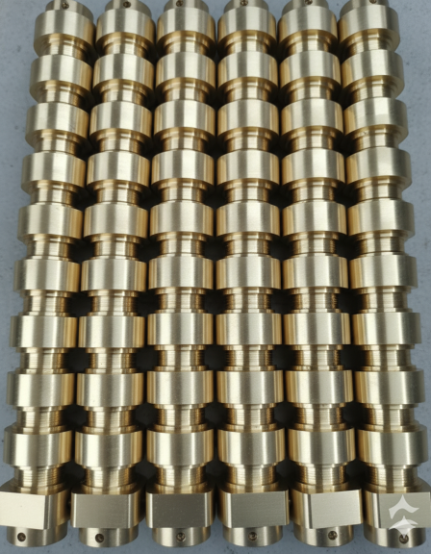
Take a close look at the parts in the photo. Internally, we joke and call them "Industrial Gold":
- The Threads:Clean, sharp, and completely free of wire edges.
- The Edges:Smooth, flawless transitions between the round threads and the flat milled surfaces. No cut fingers here.
- The Finish:Shiny and scratch-free, straight out of the machine bin.
The Bottom Line: Ready-to-Use Precision Parts
Going back to that client's original question. What clients truly need is never a "repaired part." They need a perfect component that can go straight onto their assembly line without a second thought.
In precision manufacturing, this is the standard we live by: We deliver parts that are ready to use, not parts that need fixing.
If you are tired of dealing with poor surface finishes, stubborn burrs, or assembly nightmares,contact our CNC machining experts today. Sometimes, a simple shift in machining strategy is all it takes to solve your biggest headaches.